
Time flies very fast. It has been four months since I left 584 Brigade (2022/10/26~2023/01/06). As time goes by, memories of the army fade away little by little. It is time to record memories of this period.
Preface
This story probably starts from drawing lots at the tail of boot camp. People interested in boot camp experience can read my previous article. Still remember when drawing lots everyone calculated various drawing techniques. Like analyzing units left in lot cylinder. Touching which direction of lot cylinder easier to get good lot etc. Because this batch are all Taipei soldiers. Relatively good lots like Guandu Area Command, Reserve Command etc. units around Taipei. These units easiest to go home on holiday. Bad ones like Matsu Defense Command, Hualien Defense Command these places very troublesome to go home. And like 21 Artillery, 584 Brigade are group not up not down. And unfortunately this part of lots are the most. And I just happened to draw 584 Brigade Supply Soldier.
Before going down to unit everyone inquired various information related to drawn unit from squad leader, battalion commander. And 584 is probably that kind of mediocre. Tank battalion, combat unit might be very tired. Food might be good. Sound like not particularly cool unit. Located in Hsinchu Hukou although very close to freeway. But not very easy to go home either. But thinking still have worse Hualien Defense Command. Psychologically more passable.
Second day back from boot camp leave. Under mutual farewell of boot camp peers; Carrying heavy Yellow Pu bag and terrible convenience store bread. Sat on bus to 584 Brigade. Actually still one boot camp same bed also drew this unit. Plus same company also had dozen people. This journey not lonely. Bus departed from Taichung Chenggong Ridge at ten something in morning. Three four hours later drove into Hukou camp area. Started my life in 584 Brigade.
About Phase 2 Life
Phase 2 life and boot camp are worlds apart. Boot camp had no freedom. While phase 2 had partial freedom. For example: mobile phone. Having mobile phone gave me bit more spiritual solace to survive remaining two and half months.
Tortuous Entry
When big bus from Chenggong Ridge slowly drove into camp area in Hukou we thought already arrived our new home. Actually this journey just started. When arrived bus stopped at a assembly ground of 542 Brigade camp area. Watching peers of other buses get off one after another. Doubt started in heart isn’t already arrived? About waited ten minutes bus started again. Wonderful thing happened. Bus actually slowly drove out of camp area. At this time suddenly remembered: Hukou has several camp areas. We should be going to another camp area right. Sure enough few minutes later we arrived at 584 Brigade camp area located on other side of Hukou. Came into view are old houses and cafeteria similar to Chenggong Ridge. Can’t help OS in heart: where are agreed new barracks… After stopping we were called off bus to gather at cafeteria. And started assigning units. Also simultaneously observing where called people go. Avoided waiting another period of time finally turn to us. After called out originally thought would walk to our barracks. Result we were arranged to get on a medium tactical vehicle. Followed by confusing situation happened again. We actually left camp area again. At this time suddenly remembered seems officer said 584 Brigade also has a camp area in Taoyuan. Heart shocked: no way, we going to Taoyuan!?
Medium tactical vehicle drove slowly. Slowly passed through alleys of Hukou. About passed 20 minutes. Medium tactical vehicle drove into a place never thought of: Army Northern Assessment Center. When drove into main gate still couldn’t help looking at lot in hand. I drew 584 Brigade that’s right. Have to say first impression of Northern Assessment Center is good. Here no gray black houses or camouflage bunkers. Instead red appearance building and large piece of neat beautiful lawn. Compared to army camp here more like a school. Really glad assigned here. No need to endure camp barracks broken to no good like Chenggong Ridge anymore. Later explained by officer. Due to historical factor of 584 Brigade. Combined Arms 2nd Battalion we assigned to temporarily reside in Northern Assessment Center.
About 584 Brigade
Army unit of Republic of China guarding Hsinchu County Taiwan. Assigned to Army 6th Corps Command. Armored 584 Brigade team name “Dengbu Unit”. Predecessor is Army Infantry 284th Division. Before dissolving in Jing-Shi Case this division long term stationed in Kinmen Nanxiong defense area. Therefore also known as “Nanxiong Division”.
Armored 584 Brigade. From name know we are an armored vehicle unit. So besides general military vehicles. Unit also has very many armored vehicles and tanks. Armored vehicle mainly responsible for transporting infantry to combat location. Sometimes also provide small amount firepower support. Tank mainly responsible for outputting firepower. Because armored unit here. Every day can hear sound of tanks circling in camp area. Quite spectacular.
584 Brigade has another name. Called “Dengbu” Unit. Legend during Civil War once won battle at Dengbu Island along coast of China. Later awarded name Dengbu. From here also can see 584 Brigade is unit full of history. During service period happened to encounter team anniversary. By the way visited team history museum. Is very special experience. Also deeper understanding of National Army. 584 Brigade also very solid unit. Before coming to Hukou unit stationed in Kinmen. Located at first line of defense. Requirement for combat power very high. And in 80s of Republic era only transferred back to Taiwan stationed in Hsinchu Hukou due to various reasons. Before coming Hukou was originally military important place. Have several brigades stationed here quite crowded. And 584 Brigade considered new neighbor. Therefore only can disperse parasitic in several camp areas of Hukou.
Battalion I am in called “Combined Arms 2nd Battalion”. Due to various reasons currently stationed in Army Northern Assessment Center. This place is used for testing combat power. Therefore often see many units lead team come here conduct combat, physical fitness etc. tests. Northern Assessment Center located on Shengli Road Hukou. Most Hukou people should know one side of Shengli Road from north to south all military camps. To arrive here not as easy as Chenggong Ridge. Chenggong Ridge very close to High Speed Rail station. Five minutes drive. Even can arrive by walking. And Hukou camp area distance Hsinchu High Speed Rail station at least twenty minutes drive. Closer station is Hukou Train Station. But speed not as fast as High Speed Rail. After coming out from Hsinchu High Speed Rail station just say to driver want go to first encountered camp area on Shengli Road (but formal name is Hukou 4th Camp Area) fine. Journey will pass section of tortuous climbing. Finally turn onto Shengli Road Hukou. From High Speed Rail station to camp area easier. But from camp area to High Speed Rail station very troublesome. Most time cannot call car. Even called might have to wait twenty thirty minutes. For obligatory service only few holidays want rush back Taipei not very friendly.

Dengbu Team Emblem1
Troop Type and Unit Allocation
Our batch threw to 584 Brigade roughly have following troop types: Rifleman, Clerk, Supply Soldier, Driver. Then what relationship these troop types have with doing things in phase 2? Answer is completely no relationship. Care you drew what soldier. Even if name very handsome 66 rocket soldier arrived phase 2 unit later all are Rifleman. Mainly we in boot camp stage also only received rifle training. So only can operate rifle.
Although said all riflemen. But doing things still somewhat different. And mainly related to assigned unit. You will be assigned to what unit irrelevant to drawn troop type. Purely related to company at time of boot camp. I guess they probably just purely arranged according to unit personnel demand. Therefore boot camp same company people arrived 584 Brigade later also big chance will be in same battalion and same company. Like at boot camp my company was Firepower Company. And most people in Firepower Company who drew to 584 Brigade later also assigned to Combined Arms 2nd Battalion Combat Support Company. Only few people assigned to Combined Arms 2nd Battalion Firepower Company next door. Things done in phase 2 largely related to nature of company. In Combined Arms 2nd Battalion there are companies purely providing firepower like: Firepower Company, Combat 1st Company, Combat 2nd Company… Also have purely support nature Combat Support Company. Combat Support Company responsible for support work during combat. Besides offensive firepower support also provide like food, medical, communication, maintenance related support. In terms of daily life companies purely providing firepower train more. And Combat Support Company miscellaneous things more. Can be assigned to Combat Support Company is lucky. Every time seeing people of other companies move guns ammunition out prepare war everyday evening move back. Will feel better just do miscellaneous things.
Since Combat Support Company support affairs many. Therefore internal divided into several platoons. Each platoon responsible for one business (food, medical, communication, maintenance). And platoon I assigned called Battalion Headquarters Platoon. Mainly assisting battalion officers handle various miscellaneous things. I in period contacted like help officer serve food, clean hygiene, photocopy data, build command post etc. Not considered very heavy difficult work. However because will contact battalion officer first line. Doing things how to make battalion officer happy is very important.
Phase 2 Must Bring Things
Phase 2 suddenly much more can do own things. Life no longer simple like boot camp. Therefore much more demands.
Consumption
- Small Change - Phase 2 will suddenly have many opportunities can use money. You will have lot of time can go to camp store (basically rest time can go. As long as camp store opens). Camp store besides various snacks drinks let you feel beauty of outside world. Also hot food section. If don’t want eat lunch provided by kitchen can also try fried noodles, braised pork rice, fried chicken leg of camp store. These mostly pay cash. Bring one two hundred yuan few days will spend. In addition some squad leaders very nice to voluntary service. Also willing help obligatory service take out outside food. You think yesterday eat KFC today eat Pizza hut. This is thing completely unimaginable when new recruit.
- EasyCard with Automatic Reload - That kind integrated EasyCard is simply Doraemon’s magic tool. Besides partial vending machines can use. Camp store, or further walk to OK convenience store in 542 Brigade camp area can use EasyCard. Buy whatever want buy. Very convenient.
Food
- Instant Noodles - When your action range expand to whole Hukou camp area. Almost no daily necessities cannot buy. Instant noodles same logic. However if have specific flavor want eat still can bring in from outside beforehand stock. Late night making cup noodle in dormitory really evil. Occasionally take instant noodle honor officer build relationship also can exchange little bit relax.
- Snacks - Same logic. Most snacks also can buy. Most time you will lazy walk so far go buy things. So bring in early stock more convenient. Also can sell to neighbor.
- Drinks - Drink choices in camp area less. And still have many that kind strange drinks completely never seen outside. Relatively that kind tetra pak drink choice also less. Only OK has small amount. If want drink specific models also suggest bring back when returning from holiday.
Clothing
- Jacket - Usually training time cannot wear own jacket. Except morning assembly and exercise time. My phase 2 time is November to January. This period Hsinchu wind big and cold. Really need have a warm jacket. New recruit issued white green jacket really sucks. If entering camp in winter must bring.
- Warm Clothing - Enter camp in winter must bring. Especially weather particularly cold few days night sleeping really will be cold protect. So some thick long pants or thermal underwear very necessary.
- Sneakers - Phase 2 exercise time also can wear own sneakers. So if feel issued shoes hard to wear or worn out. Then can also bring own sneakers in.
- Sport Shorts - Boot camp sport shorts only issued one. Because wear shorts every day. So usually wash once a week very disgusting. Phase 2 exercise time can wear own shorts. Usually can prevent one pants wear several days situation. Own pants also more comfortable.
- Laundry Powder - Boot camp wash clothes is clothes to wash use laundry bag concentrate find outside vendor unify send wash. Phase 2 due to such demand not big. Default is directly use washing machine on camp wash self. Then of course laundry powder part have to bring self. However our phase 2 peer obligatory service more. Discussed with officer want unify send wash. So later officer also help us find vendor handle. No need self grab washing machine someone help wash good really convenient.
Tableware
- Bowl - Phase 2 finish restaurant tableware will unify recycle keep. Phase 2 bowls plates etc. self keep. If feel meal tray provided by camp hard use, hard wash. Can also bring big bowl self. Loading dish loading rice will convenient much.
Bedding
- Quilt - Folding quilt definitely most painful thing when soldier wake up. Boot camp requirement for quilt high strive for edges and corners. Spend twenty thirty minutes folding quilt not exaggeration. Phase 2 no longer will have officer want you must spread quilt. Or you basically can directly cover own quilt. Daytime put back quilt completely never spread. Own quilt stuff back into internal affairs cabinet.
- Many Power Banks - Our company rule is night can use extension cord connect phone charger charge. But daytime only use power bank charge. Never underestimate phone usage. Since too boring in camp area. One day phone usage time is ten hours start. Naturally power bank also carry along. Usually have two power banks can ensure everyday at least one power bank has electricity.
- Power Adapter - Want charge phone or power bank then of course need that kind 110v to type-c adapter. Best bring few more backup avoid missing.
- Wired Earphone - In army principle cannot bring bluetooth earphone. Only can bring wired earphone. Phase 2 earphone also use anytime. Besides talk phone with family girlfriend use. Bored want low profile watch drama, watch youtube also very useful. Just wear earphone in training time be sure low profile. Seen by officer still will angry. Also earphone also suggest bring few more. Since usage chance many. Broken chance also many. I in camp area had accidentally pull break one. Again no prepare backup. Cause that week want talk phone or watch video become very troublesome.
Medicine
- Cold Medicine - Once arrive phase 2 suddenly become easily catch cold. Possibly chance stay in closed space with neighbor increase. When catch cold although Northern Assessment Center has infirmary. But medical officer quite useless. Besides prescribe some comprehensive cold medicine only will transfer. So if symptom not too serious then eat cold medicine self fine.
- Mosquito Repellent - Phase 2 officer also won’t require you must hang mosquito net. Although night sleep window will close. But inevitably have mosquito sneak in and drive not away. At this time only can rely on mosquito repellent or some anti-itch medicine.
Daily Schedule
Compared to boot camp every link planned well. Phase 2 life relatively much flexible. Except assembly time very fixed. Daily assembly time, rest time, eating time not that fixed. Mostly will different according to daily training, business content. Compared boot camp that kind every minute every second very critical life. Phase 2 really pressure small much. Daily schedule roughly as follows:
- 06:00 Wake Up - Our phase 2 time is according to winter time. Wake up time compare summer time 05:30 can have 30 minutes more sleep time. Phase 2 unlike boot camp will wake up earlier 30 minutes. Anyway requirement for quilt not high. Morning about spend ten minutes can settle quilt and wash.
- 06:20 Assembly - After wash can slowly move to assembly ground assemble. This assembly wear usual exercise uniform fine. Unlike boot camp only obligatory service assemble. Yesterday duty stay obligatory service will also assemble. Watching obligatory service also look sleepy very interesting. This assembly is duty squad leader roughly look person missing or not. Not missing squad leader mood good bring everyone do some exercise. But most time directly release everyone go down eat breakfast. Suggest steal bowl chopsticks stuff into pocket bring down when assemble. So no need run back dormitory one more trip.
- 06:00 ~ 06:30 Eat Breakfast - Compared to boot camp too many people restaurant cannot sit. Phase 2 after breakfast time restaurant super empty. Voluntary service have outside eating sleeping rarely come in eat breakfast. We obligatory service sometimes also want go back steal sleep. Also not necessarily want eat. 584 Brigade breakfast beginning come very delicious. Later don’t know why worse and worse. Only left steamed bun, few small dishes, porridge, and sweet soup. Mediocre.
- 07:30 Assembly - This assembly want full gear (helmet, S-belt). Then will conduct singing counting numbers. That is first come few singing counting numbers. Then lead sing military song like “Army in Charge”.
- 07:30 ~ 11:00 Training Class - See what schedule of day is. Since our unit experiencing pre-base training. Therefore quite a lot training content targeting down base like CPR, combat injury rescue, night vision goggles etc. Mainly still train voluntary service. Obligatory service beside fill number. No class then maintain gun in Zhongshan room or slide phone be redundant. Occasionally called out help.
- 11:00 ~ 12:00 Lunch - Different from boot camp. Lunch before no longer assemble. Just after class respective return dormitory unload gear take bowl chopsticks then self go restaurant eat. Finish eat self return rest. Lunch compared boot camp quite good. Usually have two to three main dishes. Then dish amount also very sufficient. Won’t have dish not enough situation in boot camp. In addition one sweet one salty soup can choose. Sometimes have add dish. Can eat something different like hot pot.
- 12:00 ~ 13:30 Nap - Nap just return dormitory rest sleep. Don’t mess do whatever want do. No one will care you.
- 13:30 Assembly - Same also full gear. Again one more time singing counting numbers. Sometimes noon have duty (wash meal bucket kind work) can makeup rest until two o’clock. Can upstairs dormitory steal listen downstairs how this military song sing. Obligatory service since often practice all can sing. But voluntary service since usually busy all not quite can sing. Overall depend on obligatory service pull high average value otherwise will be scolded by battalion duty officer.
- 14:10 ~ 16:00 Training Class - Continue doing things similar to morning.
- 16:00 ~ 17:00 Exercise - Different from boot camp. Phase 2 has exercise time. Sometimes company commander mood good will come lead physical training. Otherwise usually run then go basketball court play ball. Really quite healthy life. Later I and few peers will long run to 542 camp area together. About three kilometers. Way back drop by Hi-Life steal buy something.
- 17:00 ~ 18:00 Dinner - Eating same things as lunch. However voluntary service since have outside eating sleeping. So people eat not many.
- 18:00 ~ 19:00 Washing Up - See you want wash bath this time or not. Not wash later also have chance. Not anxious.
- 19:00 Assembly - This assembly only assemble obligatory service see person missing or not. Then find some things give obligatory service do at night. Most time just practice military song practice one hour or clean environment. Meet better duty squad leader assemble finish directly release us down rest.
- 19:00 ~ 20:00 Night Class - Same as above. Just practice military song and clean. More special have night march and night shooting. But only each once. But is very rare experience.
- 20:00 ~ 22:00 Free Time - Same just do whatever want. At this time not washed yet go wash. Otherwise rot in dormitory. Watch youtube, play phone, find girlfriend chat.
- 22:00 Bedtime - Bedtime turn off light. However want sleep or not is your business. Want play phone until dawn also fine. Sometimes also will ask outside eating sleeping voluntary service bring some good food from outside in this time eat.
Special Activities
The daily schedule above describes what an ordinary day was like, but of course I did not spend every day of those two-plus months simply cleaning rifles, scrolling through my phone, and playing basketball. Every now and then, something more unusual would be added to the schedule. Some activities returned every so often, while others happened only once during the entire second phase. Those rare events ended up becoming some of my clearest memories of military life.
Weekly Maintenance
Despite the name, “weekly maintenance” did not necessarily happen every week. It mostly depended on the schedule—and perhaps the mood—of the officers above us. The main task was to sign the rifles out of the arms room one by one and have us conscripts clean them. We had already learned the procedure in boot camp: field-strip the rifle, remove the barrel and other parts, wipe away the carbon buildup and old oil, apply fresh oil, and assemble everything again.
A squad leader usually stayed nearby to make sure we were not fooling around and to check whether the rifles were actually clean. Each person was normally responsible for two or three rifles. Once we had finished, we could sit off to the side and use our phones. It was a very typical second-phase assignment and, all things considered, not especially difficult.
Night March
I think we only did one night march during the months I was there. The Hukou military area is enormous, with several brigades and camp areas inside it, while the Northern Assessment Center sits toward the southern side. Walking across the entire area would take a very long time. On our night march, we started at the Northern Assessment Center, walked toward a gate on the other side, and then followed the same route back.
In theory, a night march should include scenarios and evaluations, such as how to respond when a certain situation occurs, although I no longer remember the details very clearly. What I remember most is that the officers never told us where the destination was or how much farther we had to go. We simply kept following the people in front. Dozens of people from the company marched through the dark for around two or three hours, and not knowing when we would finally turn around made it surprisingly tiring. Still, it was a special experience. We got to see Hukou at night: some areas were completely dark and deserted, while others were still lively. It felt very different from what we saw during the day.
Night Firing
Night firing was another special activity that happened only once during my second phase. An enemy will not necessarily appear only during daylight, so besides regular daytime marksmanship, soldiers also need to understand how to use night-vision equipment and fire in the dark. That evening we rode a medium tactical vehicle to the range. The procedure was mostly the same as an ordinary range session, except that it took place at night and there was almost no light around us.
Firing ranges are usually located in quieter, more remote corners of a camp, and this one had air-raid shelters and similar structures nearby. Before we left, the senior soldiers and squad leaders kept telling us that the place was haunted. When we stepped off the vehicle into almost total darkness and remembered all the stories we had just heard, it was honestly a little frightening. Putting the creepy atmosphere aside, however, getting to fire a rifle at night was still a rare experience.
Company Inspection
Because we belonged to the Combat Support Company, the company was divided into several platoons with different responsibilities, including the Battalion Headquarters Platoon and the Medical Platoon. The purpose of the company inspection was to confirm that every platoon had all of the equipment, supplies, and resources it was supposed to have. For us, that meant moving virtually everything owned by the Headquarters Platoon outside so it could be counted and inspected. I have already forgotten exactly what was checked; I mainly remember moving things around over and over again.
Pre-Base Training and Assessment
The timing of our arrival at Combined Arms 2nd Battalion was rather special because the unit was scheduled to begin a training-base cycle a few months later. Before entering the base, every unit first had to complete pre-base training and then pass the corresponding assessment to show that it was ready. Since we belonged to an armored brigade, armored-vehicle and tank operations naturally formed an important part of the program. There were also basic infantry combat skills and physical-fitness training.
The training was primarily intended for the career personnel who would actually enter the training base. We conscripts usually attended classes with them, helped with miscellaneous tasks, or simply stood nearby to fill out the numbers. Even so, arriving during pre-base training gave us the chance to experience many things that would never appear in ordinary boot camp, which made this posting rather unusual.
Training Classes
Training during the pre-base period was both broader and more varied than boot camp. For example, grenade practice in boot camp mostly meant throwing straight ahead, while here we also practiced throwing a grenade through a window and responding to situations that felt closer to actual combat. Rifle training was no longer limited to firing prone. We practiced switching among three positions: prone, kneeling on one knee, and standing. It made sense—on a real battlefield, nobody can expect to lie down comfortably and take their time with every shot—so the exercise was quite interesting.
There was ordinary physical training as well. The instructors led us through push-ups, sit-ups, running, and pull-ups, and sometimes we trained in full gear with helmets and S-belts. We were also introduced to techniques for disarming knives and guns and to basic control holds. Whether I could actually use any of them if I met a criminal is another question, but learning how one is supposed to respond was still fun.
Another important subject was combat casualty care. We learned how to use a tourniquet, perform CPR, and operate an AED. We had to memorize the steps and were tested on them later. We practiced these skills so many times that eventually my reaction was, “CPR again?” Still, first aid is one of the few military skills that might genuinely remain useful in civilian life, and the instructors repeatedly encouraged us to take it seriously.
Political Warfare Class
As far as I remember, we had a political warfare class about once a week. It was not exactly a relaxing class because we had to sit there without casually using our phones. Most of the time, the political warfare officer delivered announcements or showed us Juguang Garden (莒光園地), the military’s political-education program. The topics were the familiar ones: avoiding fraud and drugs, watching out for attempts by Chinese intelligence to recruit people, and not posting reckless comments online. The same warnings appeared again and again. That was basically what a normal political warfare class looked like.
Inspections by Senior Officers
During training or equipment maintenance, the battalion commander, brigade commander, or other officers from battalion and brigade headquarters would occasionally come by to inspect us. Naturally, everyone would suddenly become extremely serious. If we were maintaining vehicles, we would work while also watching the officers’ movements, then scrub especially hard when they came near us. If an officer appeared right after we started putting on our best performance, we would think, “Nice—we intercepted him at exactly the right moment.” He had arrived just in time to see us at our most diligent. Of course, senior officers could appear out of nowhere, so we did not always get the chance to perform for them.
Exercise Time
Every afternoon at around four or five, we had a period set aside for exercise. What we did depended on whether the officers had arranged anything special that day. If they thought our fitness was poor, they might have everyone run three or five kilometers or add extra push-ups and sit-ups. If there was no special requirement, we would usually run one or three kilometers first and then be released to play basketball, sometimes continuing until six or seven in the evening.
This was one of the most relaxing parts of the day. A group of young men could simply run around the basketball court, while anyone who did not want to play could go running instead. Later, I often ran around the camp with several people from my intake and one of the squad leaders, usually covering about three kilometers round trip. Whether or not our fitness became dramatically better, exercising every day was a healthy and surprisingly happy routine.
Hsinchu Weather
Hsinchu is famous throughout Taiwan for its wind, and the Northern Assessment Center sits on something like a small hill with a mountain behind it. The wind was much stronger than what I was used to in Taipei. We arrived around November and stayed until January of the following year, right through the coldest part of the Taiwanese winter. Standing outside for morning assembly or evening activities while the wind kept blowing was genuinely cold.
The barracks windows did not seal very tightly, so cold air came straight into the room on windy days. At night we could hear the wind whistling and the windows rattling. Hsinchu seemed to get less rain than Taipei, so the wind was really the main problem. During those months, warm clothing and a personal quilt were essential.
Duty Team
There are always shared duties that each company or platoon must take turns covering, such as cleaning, taking out garbage, moving food supplies, washing dishes, and looking after common areas. The people temporarily assigned to those jobs formed the duty team. Being selected produced mixed feelings. On the positive side, we could leave training early, sometimes receive compensatory rest in the afternoon, or even skip morning assembly. Once the work actually began, however, it was not easy at all. On a busy day, staying with the original formation or training class might have been more relaxing, so it was hard to say whether we had really gained anything.
The Officers and NCOs
Most of the career personnel in the Combat Support Company were NCOs. Apart from a small number of newly enlisted career soldiers, most of the ordinary soldiers were conscripts like us. The company naturally also had commissioned officers, including the company commander, deputy commander, political warfare officer, and medical officer. However, the person who actually led us was not a platoon leader but an assistant platoon leader. Our Headquarters Platoon seemed not to have a platoon leader at the time—or at least there were very few of them—and I remember the other platoons being similar.
The military has both commissioned-officer and NCO systems. A platoon leader is normally a second or first lieutenant, while an assistant platoon leader is usually a senior NCO, often a sergeant major. ROC Army officers rotate among different units, whereas some experienced NCOs may remain in the same unit for a very long time. They know every person, procedure, and unwritten rule and are basically the unit’s old hands. As a result, even when an officer is formally responsible for a routine task, getting it done still depends heavily on the knowledge and help of those senior NCOs.
Company Responsibilities
The full name of our unit was the Combat Support Company. As the name suggests, its job was to support the other companies during combat. The company contained the Battalion Headquarters Platoon, Medical Platoon, and other sections responsible for headquarters operations, medicine and sanitation, communications, maintenance, logistics, and casualty transport. When necessary, it could also provide other forms of support to the combat companies. Compared with tank companies and other frontline units, we did not have as many tanks; most of the vehicles we saw were used to move people and supplies.
I was assigned to the Battalion Headquarters Platoon, which supported the battalion’s senior officers. Our daily work was difficult to summarize because it could include serving meals, cleaning, photocopying documents, moving equipment, or setting up a command post. Most of it was neither very difficult nor especially heavy, but because we worked directly with battalion-level officers, we had to learn how to complete everything properly and avoid giving them a reason to find fault with us.
Food
The food after assignment to the unit was much better than I expected and, in my opinion, far better than the mass-produced meals at boot camp. Most dishes tasted as if someone had actually seasoned them with care. A normal meal included vegetables, meat, and soup, usually with both a sweet and a savory soup available. Occasionally we would get fried chicken legs, fried noodles, or some other dish that looked deliberately planned, instead of the fluorescent curry from boot camp that made us wonder what had been put into it.
When we first arrived, there were fewer people in the company and the meals looked especially good. Sometimes we even received pudding or ingredients that seemed unusually expensive. After our intake joined and the kitchen had to prepare larger portions, those treats gradually disappeared. Still, the cooking remained good overall. If the officers were in a generous mood or there was a special occasion, we would receive extra dishes and sometimes even hot pot. Going to the dining hall was usually one of the happier parts of the day.
Accommodation
I heard that the accommodation at the Northern Assessment Center was much better than in a typical combat unit. When I first arrived, the whole camp reminded me of a school. Our dormitory looked like someone had emptied a high-school classroom and filled it with rows of military bunk beds. The conscripts from the same platoon lived together; there were about seven or eight of us in the Headquarters Platoon, all sleeping in the same room, and we naturally became fairly close over time.
The standard military mattress was no more comfortable than the one at boot camp, and neither was the pillow, but after a tiring day it was still easy enough to sleep. One major difference was that we could bring our own quilts. With Hukou’s cold winter wind, the extra warmth was important, but a personal quilt had another equally important purpose: the issued quilt never had to be unfolded.
Everyone knows that barracks housekeeping matters in the military. Even in a combat unit, the officers would still point it out if our area looked too terrible, and folding a quilt was one of the most annoying parts of every morning. If we slept under our own quilt, we could move the issued quilt and mosquito net aside at night, put away our own bedding in the morning, and return the perfectly folded issued quilt—which had never been opened—to its official position. We still had to stuff our personal quilt into the locker, but overall it saved a great deal of effort. It was a shortcut everyone knew.
Completion of Training
As military-training-service conscripts, we could use military education courses taken at university to deduct days from our service. That meant everyone finished on a slightly different date, and naturally people deducted as many days as possible. Some managed to claim the maximum. I think I deducted only seven or eight days, although I no longer remember the exact number. As the end approached, we watched the people with the most deductions receive their completion documents and happily leave before the rest of us, while everyone else waited for his own date.
When my turn finally came, the main task was to count and return every item of issued equipment, make sure nothing was missing, and receive the completion order. Then I picked up the rest of my belongings and walked out of the camp. There was nothing particularly solemn or heroic about leaving. Most of us were simply thinking, “It is finally over.” We walked through the gate without looking back, happily returning to the outside world and the next stage of life.
Reflections
Things You Must Pay Attention To
Always Keep MDM Updated
Anyone who has completed boot camp should know MDM, the management software the ROC Armed Forces installs on our phones. Before entering camp, we had to use it to lock down the phone, and only after leaving for vacation could we unlock it again. The app did not seem important when everything worked, but keeping it updated was essential because old versions could cause all kinds of strange problems.
People in our intake regularly forgot to update it and then discovered that they could not lock their phones when returning from leave, could not unlock them after leaving camp, or sometimes could not even remove the software. The biggest problem was that a phone that could not be locked generally could not enter the camp, and the officers inside did not necessarily know how to fix it. That was why the squad leaders constantly reminded us: always keep MDM updated. Do not wait until you reach the gate to discover that something is wrong.
Do Not Assume You Can Act Like a Jerk After Boot Camp
The instructors in boot camp were extremely strict because their job, as they described it, was to turn us “from civilians into soldiers.” That transformation required a period of high-pressure education and discipline. After assignment to a unit, the atmosphere suddenly became much more relaxed. Most of the NCOs were only somewhat older than us, and the relationship felt more like seniors guiding juniors than boot-camp instructors constantly trying to educate new recruits.
A relaxed atmosphere does not mean that it is acceptable to become obnoxious. There are always people who notice that the squad leaders are less aggressive and begin causing trouble, testing the NCOs’ limits, or even acting as if they can walk all over them. Unsurprisingly, the squad leaders then become strict again and will still yell when yelling is necessary. It is nice to have a more friendly relationship with the people leading you, but basic discipline and a sense of boundaries still matter. The NCOs are there to do a job; there is no reason to make that job harder just to test how much they will tolerate.
Unforgettable Experiences
The Legendary Fifth Camp Area
So many units are stationed around Hukou that the wider military area is roughly divided into the First, Second, Third, and Fourth Camp Areas. Logically, there should only be four. Why, then, did soldiers keep talking about a “Fifth Camp Area”?
According to the story, there is an area near Hukou where adult-entertainment businesses are concentrated, and some soldiers supposedly visit it during leave. Over time, people jokingly named it the Fifth Camp Area: a place where soldiers gathered even though it was not an actual military camp. This was only a story passed around inside the army. I never verified it, so it may simply be an urban legend handed down from one intake to the next, haha.
Taking a Shortcut During the Fitness Test
To encourage everyone to improve his fitness, the company once offered a very attractive reward. As I remember it, anyone who completed the three-kilometer run in about eleven minutes could be released at 1200 on Friday—what we called fang yao-er (放么二). The official release time seemed to be 0800 on Saturday, or dong-ba (洞八), while after assignment to a unit the officers normally let us leave at 1800 on Friday, fang yao-ba (放么八). Being allowed to leave another six hours earlier was incredibly attractive to conscripts with almost no freedom.
Where there is a reward, someone will try to cheat. Our fitness test followed a loop around the camp, and one person from our intake, despite not being fast enough, secretly “cut the watermelon”—the military expression for cutting across the course—and pretended to finish within the target time. I do not know whether somebody reported him, but the truth eventually came out. He cheated to gain a few extra hours of leave and instead was held until Saturday morning for several weeks. It was really not worth it. Still, every intake includes a few unusually mischievous and uncontrollable people, and this became one of the stories I remember most clearly.
Exploring the Camp
As mentioned in the exercise section, several people from my intake and I often ran around the camp. The Hukou military area is so large that we could run from the Northern Assessment Center to a gate on the opposite side and then return, sometimes stopping at Hi-Life or a camp store on the way back. Calling it exercise was only partly accurate; it also felt like exploring the camp.
There may never be another time in my life when I can casually look around inside a military installation, so within the areas where we were permitted to move, we wanted to see what everything looked like. Conditions varied dramatically between units. Some areas were busy and had modern barracks, while others were so empty and run-down that they looked almost abandoned. Running gave us a way to slowly learn the layout and see how people in other units lived. It was genuinely interesting.
Extra Dishes and a Magic Show
Besides normal meals, we occasionally received extra dishes for birthday celebrations or other special events. About once a month, as I remember it, there would be something like a birthday party, with hot pot, pizza, or outside caterers coming into camp to prepare a full meal. Compared with eating roughly the same kitchen food every day, these occasions naturally made everyone very happy.
One of those events was especially memorable for me. I may have written in my soldier’s diary that I had belonged to a magic club, or perhaps mentioned it in conversation. Either way, an officer eventually asked whether I wanted to perform magic onstage. Military life was extremely boring, so I thought it would be a good opportunity to recover the feeling of performing and volunteered to do it.
Agreeing to perform brought some unexpected privileges. Because I needed time to prepare, I was excused from normal training for about three or four days. The counseling officer arranged a small room where I could practice in private, and whenever I needed an item or wanted someone to watch and judge an effect, people were willing to help. The final performance went well, the audience seemed happy, and afterward the battalion commander personally presented me with a small prize. I never expected to perform magic for so many officers inside a military camp. Looking back, the experience still feels special, and I am a little proud of it.
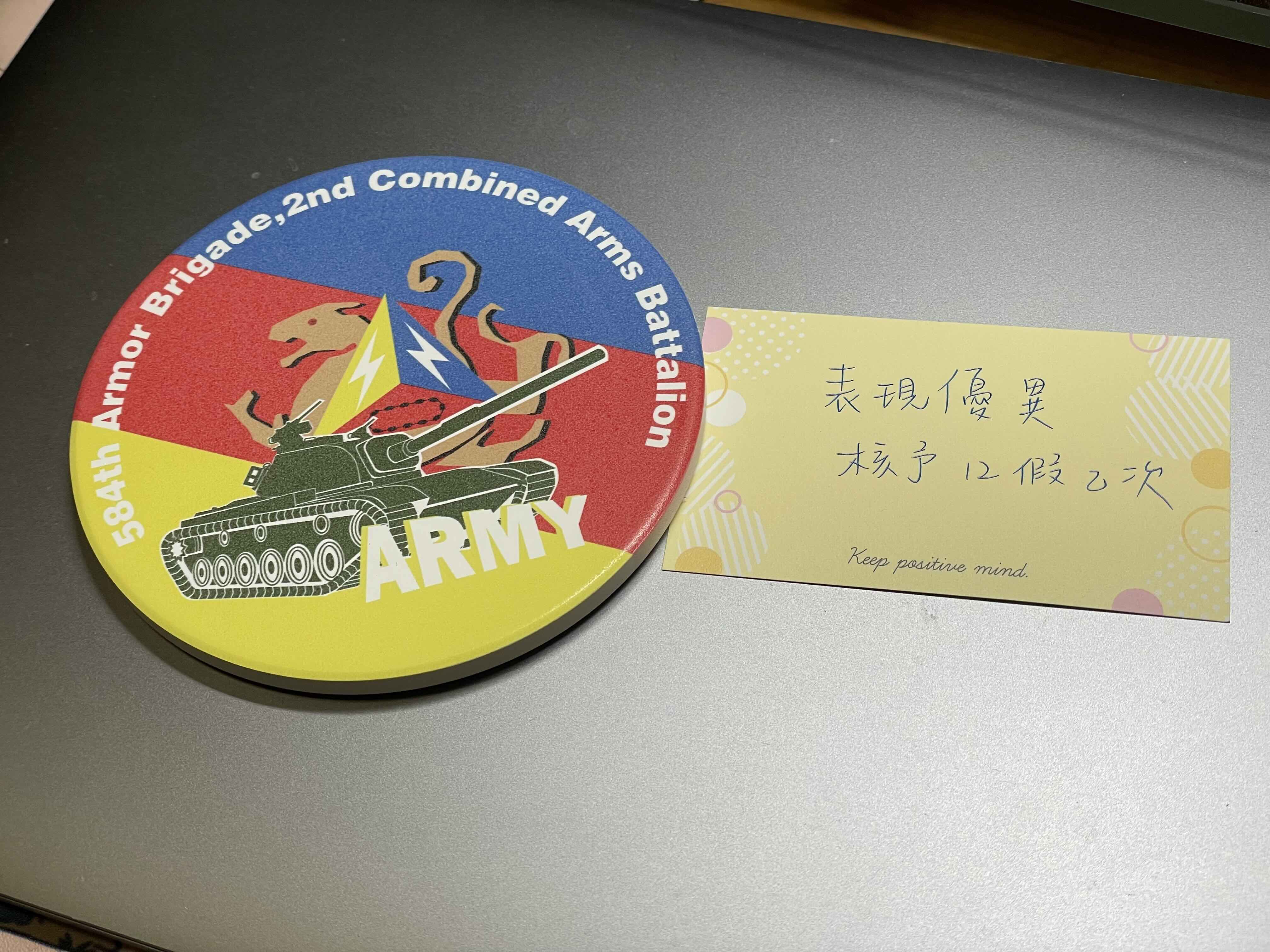 The prize I received for my magic performance
Eating Takeout in the Dormitory
Career personnel were allowed to eat and sleep off base. If they had no evening duty, they could eat outside or even sleep at home, as long as they returned on time for work the following morning. We conscripts did not have that freedom. We were limited to the mess hall, camp store, and whatever could be bought inside the installation, which naturally became repetitive after several months.
Fortunately, most of the NCOs in our company treated us well. When they went outside for dinner, they sometimes asked what we wanted and brought back fried chicken, Taiwanese salty fried chicken, salt-water chicken, or pizza. We tried not to make a big show of outside food in the camp. Instead, a few of us would gather in our tiny dormitory and quietly have a party. A meal that would have been completely ordinary outside somehow tasted much better inside the camp, and those evenings became some of my happiest memories from the unit.
Going Out for Drinks with Our Superiors
Alcohol was not allowed inside the camp, but drinking in moderation while off duty and outside was another matter. Across from the Hukou camp gate was a row of Taiwanese stir-fry restaurants, probably because the owners knew that so many soldiers nearby would want dinner and a beer whenever they were free. The area always seemed to have plenty of business.
During my service, the sergeant major and squad leaders invited us out several times for food and drinks. It was my first real experience of being pressured to drink by superiors. Nobody had treated us that way as students, so sitting in a stir-fry restaurant drinking beer with a group of NCOs gave me the odd feeling that I was leaving student life behind and slowly entering the adult working world.
The Soldiers Who Always Returned at the Last Possible Minute
After weekend leave, we normally assembled for roll call at 7 p.m. on Sunday, and everyone had to be back at the company’s assembly point before then. This was also during a more serious stage of the COVID-19 pandemic, so after returning we had to complete roll call, urine testing, rapid testing, and several other procedures. Returning late was not an ordinary case of tardiness; the officers might have to report it up the chain of command. Being on time was extremely important.
Even so, every unit has a few people who love pushing the deadline. They knew assembly was at seven but would still rush through the gate at 6:59. Sometimes they were late and did not answer their phones, making the entire company nervous. The officers had to decide whether to report the absence or wait a little longer in case the person appeared. Often, just as everyone was becoming desperate, the missing soldier would finally stroll in as if nothing had happened.
Most people in our intake were from Taipei, so weekend travel meant moving between Hukou and Taipei. Some took a taxi to Hsinchu High Speed Rail Station, while others went to Hukou or Xinfeng for a conventional train. At peak times it could be difficult to find a taxi, and taking a bus required even more time. Misjudging any part of the journey could make someone late. Military service taught me that punctuality really matters. It is better to return early and wait inside than to make the entire company worry about you.
Endless CPR Practice
CPR was one of the tested subjects in pre-base training. There were many steps, and repetition was the only way to memorize them. The problem was that every officer, NCO, and career soldier had his own duties, making it difficult to gather everyone for a single class. The unit therefore scheduled the same lesson many times so people with different schedules could attend in separate groups.
That arrangement made perfect sense for people with regular duties, but we conscripts usually had little else to do. Whenever someone offered a CPR class, we were called over to join it. We ended up covering the same material five, six, perhaps seven or eight times. It genuinely felt as if the training would never end, and eventually merely seeing Resusci Anne, the CPR mannequin, became annoying.
Pre-Base Training Opening Ceremony
Before the unit began its training-base cycle, it held a formal opening ceremony. Many senior officers from brigade and even corps level attended, so the event could not consist of everyone merely standing in place and listening to speeches. We had to demonstrate our determination and confidence in completing the training.
We rehearsed a marching entrance, bayonet movements, and other displays designed to project energy and discipline. The career personnel were busy with their normal duties, so conscripts without fixed assignments became the main performers. We spent a considerable amount of time repeating the movements before finally completing the ceremony together. At heart it was a performance for senior officers, but it was also an experience one could probably have only in the military.
A Handsome Battalion Commander and a One-Star Brigade Commander
Our battalion commander at the time was very handsome. I heard that he was also highly educated and had attended military training overseas. When he spoke at gatherings and formations, it was obvious that he had read and thought seriously. He did more than repeat slogans; his speeches contained ideas and principles of his own. As a result, he was quite well respected within the unit.
Before entering the army, I had no concrete idea of what a general was actually like. The word suggested someone extremely dignified, serious, and distant from ordinary people. The commander of 584 Brigade happened to be a major general with one star on his shoulders. He personally presided over the pre-base training opening ceremony, giving us our first close look at a real general. So that was what an actual general looked like. It was honestly pretty cool.
Family Day
Combined Arms 2nd Battalion organized a family day for us conscripts, allowing relatives to enter the camp and see where we lived, trained, and spent our days. My girlfriend came to visit me at Hukou. Civilians normally have no opportunity to casually enter a military installation, so it was interesting to show her the Northern Assessment Center and let her see what I looked like in uniform.
We were released for leave immediately after the event. One moment we were showing people our dormitory, and the next we could walk out of the camp with them. For us, that was probably the part of the entire family day we anticipated most.
Inspections by the Northern Assessment Center
Although we belonged to 584 Brigade, Combined Arms 2nd Battalion was only temporarily staying at the Northern Assessment Center. The brigade’s own camps were elsewhere in Hukou. Since we were living on someone else’s property, we answered not only to our own battalion and brigade but also to the Northern Assessment Center’s officers.
We regularly encountered their officers patrolling and inspecting our area to see whether we were doing anything excessive or inappropriate. If they saw a problem, they could stop us, correct us, or scold us just like our own superiors. It was a little like staying in somebody else’s house: we had to listen to our own family while also obeying the homeowner’s rules.
The 7-ELEVEN Vending Machine
There was no convenience store inside the Northern Assessment Center. We could walk to a Hi-Life or camp store elsewhere in the wider military area, but neither was close, and the camp store opened for only a few hours each day rather than operating around the clock. What could we do if we suddenly became hungry late at night? That was when the 7-ELEVEN vending machine became incredibly important.
The machine was surprisingly capable. It contained snacks, small cartons of soy milk and regular milk, instant noodles, rice balls, and bread—almost everything one could imagine fitting inside it. The selection could not match a real convenience store, but in a camp with nowhere else to buy food at night, it was our source of spiritual nourishment. It was wonderful.
A Fellow Soldier Who Returned from Hong Kong
During military service, it was not unusual to meet people who had lived in the United States, Canada, Hong Kong, or elsewhere and later returned to Taiwan to complete their service obligation. One member of our Headquarters Platoon had come back from Hong Kong, and his bed happened to be next to mine, so we had many opportunities to talk.
His language, culture, and childhood education were different from ours. Having him in the unit felt a little like having an international student in a university class. We exchanged stories about life in Taiwan, Hong Kong, and other places, and our different perspectives created many interesting conversations. I never expected military service to introduce me to someone with such a different background, and I was happy to make a new friend.
Conclusion
During boot camp, we were simply placed in a high-pressure environment and pushed through the process of changing “from civilians into soldiers.” Every day, we focused on completing the task in front of us and avoiding being yelled at. There was no room to understand how the military actually operated. Only after assignment to a regular unit did I begin to see how a battalion lived, trained, and handled its responsibilities, and how its officers and NCOs viewed their work and the duty of defending the country.
The military certainly has many strange habits, and sometimes it makes people do things that appear completely pointless. Looking more closely, however, I found that some practices had emerged from decades of military experience and were not entirely without reason. People at the bottom are rarely told those reasons; they have to observe and slowly understand them for themselves. Of course, not every pointless task eventually reveals a wise explanation. Some things genuinely need to be improved.
Overall, however, my impression of the people I met during those months was positive. Most officers and NCOs valued their honor and genuinely wanted to fulfill their responsibility to defend the country. The clearest example was how seriously many NCOs treated physical fitness. If a war actually begins, a soldier’s body is his most basic and important tool, so they worked hard to keep themselves ready. To me, that was a very direct expression of professionalism.
The commissioned officers showed the same attitude in a different way. The company commander worked hard to improve the company, while the battalion commander used longer-term ideas and principles to encourage people, build morale, and improve the unit’s combat skills and capabilities. Before serving, I might have seen soldiers simply as a group of people in uniform. After living inside a unit, I understood that many of them took their identity seriously and worked hard to do what was expected of them.
The armed forces still face many practical problems and frustrations. Beyond the meaningless tasks, pay, working conditions, and the public’s long-standing negative image of military personnel all leave a great deal of room for improvement. The situation seems to have become much better in recent years, but some problems are too broad to change quickly. I can only hope that things improve little by little in the future.
In the end, those months convinced me that if war ever comes, this unit has both the ability and the willingness to stand up and defend our country, and I am willing to trust them. Now that I work in civilian life, the experience has also made me understand more clearly where part of my taxes goes and that a group of people is preparing for events everyone hopes will never happen. At least when I pay taxes now, I do so willingly, because I believe that if that day truly arrives, they will fulfill their responsibility.
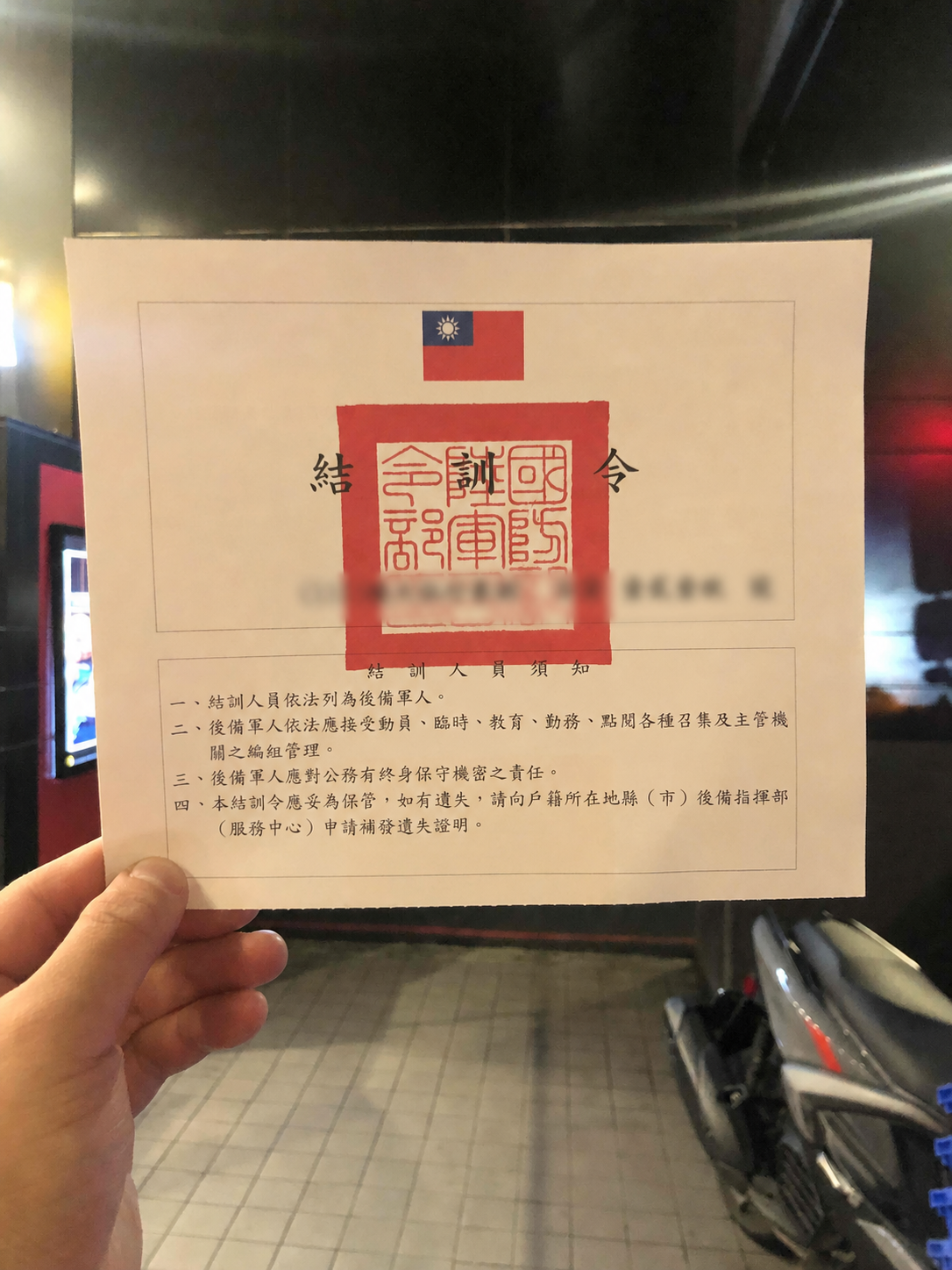 Training completion order